Ventilation: the invisible system that decides your roof's lifespan
A lot of 'roof problems' turn out the same way when we open them up: the shingles were fine. The attic under them was cooking the roof from below in summer and building ice dams in winter, and no shingle survives that indefinitely. Ventilation is the system nobody sees and everybody pays for.
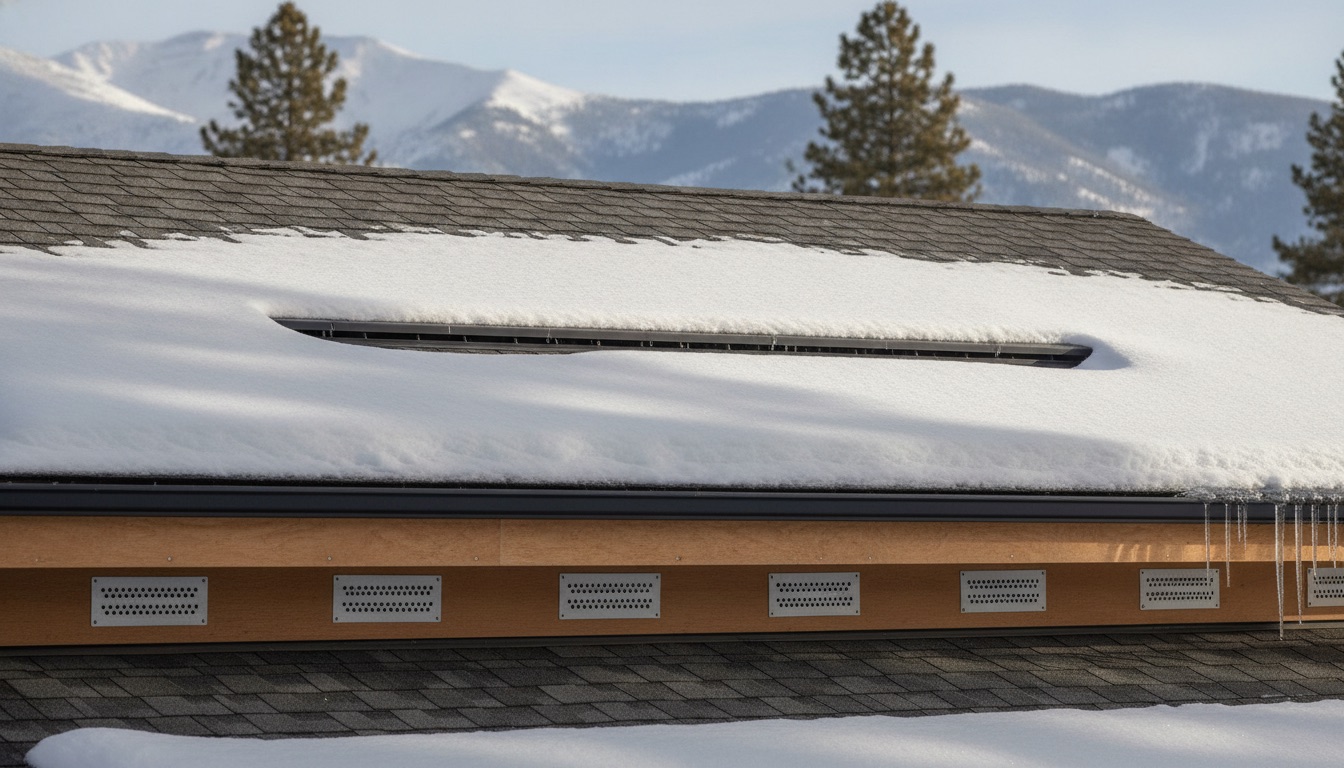
The physics is simple. Air needs to enter low (intake, at the soffits under your eaves) and exit high (exhaust, at or near the ridge). Warm air rises through the attic and carries heat and moisture out the top, pulling fresh air in at the bottom. That continuous wash of air keeps the roof deck close to outside temperature, which is the entire game.
In winter, a warm roof deck is the ice-dam machine: it melts the snowpack from below, the water runs to the cold eave, and it refreezes into a dam that pries up shingles and pushes water into your ceilings. In summer, a 150-degree attic bakes the asphalt binder out of shingles years ahead of schedule and can cook the sheathing itself. Same cause, both seasons: the deck isn't at outside temperature.
Balance matters more than volume. Exhaust without intake pulls air from somewhere, usually your house, dragging conditioned air (and moisture) into the attic. The classic mountain-home mistake is a beautiful ridge vent over soffits that were painted shut, insulated over, or never cut in. And never mix exhaust types: a power vent or box vents on a roof with a ridge vent short-circuits the system, pulling air vent-to-vent across the top of the attic while the deck below sits in still, warm air.
Every reroof we do gets a ventilation calculation (net free area, intake-to-exhaust balance, baffle checks at the eaves), because installing new shingles over a broken airflow system is installing them on borrowed time. It's also one of the best standalone repairs on an otherwise healthy roof: correcting ventilation is a fraction of a reroof and routinely adds years to the system above it.
Questions about your roof?
Free inspection, photo report, and straight answers within 48 hours.